
Rising health insurance costs are shrinking raises. In a recent Federal Reserve Bank of New York survey, businesses that saw insurance costs rise gave an average of 3.8%. Without those cost increases, the said raises would have been ~4.7%.
That gap is where healthcare costs and paychecks meet. In Wisconsin particularly, where hospital prices are the highest in the Midwest, the squeeze is even tighter for employers and employees alike.
To help you stay knowledgeable, we’ll discuss the rising healthcare costs, what this means for hiring and retention, and how a Staffing & Consulting Agency can assist with hiring.
Key Takeaways
- Raises are getting smaller: Rising insurance costs cut about one percentage point from average raises, and 83% of employers say healthcare costs force tradeoffs with pay increases.
- Workers pay twice: Once through premiums and deductibles, and again through slower wage growth.
- Wisconsin employers feel it more: 93% of Wisconsin employers with health plans saw costs rise in 2026, and the state’s hospital prices rank fourth-highest in the nation.
- Retention is on the line: Workers compare take-home pay, not total compensation. Clear communication, smart plan design, and flexible workforce planning help protect your team.
How Fast Are Healthcare Costs Rising?
Healthcare costs are rising faster than wages and general inflation. Employers name three main cost drivers: high drug prices (77%), high-cost claims (75%), and hospital prices (68%).
Here are current state of healthcare statistics to consider:
- The average family premium hit $26,993 in 2025. Workers paid $6,850 of that.
- 83% of employers say healthcare cost spikes force tradeoffs with raises.
- 93% of employers expect to shift more costs to workers.
- Insurers are requesting a median 14% premium increase for small-group plans next year.
- 34% of covered workers now face a deductible of $2,000 or more.
- Hospitals and facilities make up nearly 31% of employer healthcare spending.
What Does the Long-Term Data Show?
For the long haul, healthcare costs have outpaced wages for more than two decades. Notably, Wisconsin is one of the most expensive states in the country for healthcare. That puts local employers at a disadvantage when budgeting for pay and benefits.
Here is what the long-term data is showing:
- Family premiums rose 365% between 1999 and 2025, from $5,809 to $26,993.
- Over a similar period, Wisconsin’s median household income rose about 83%.
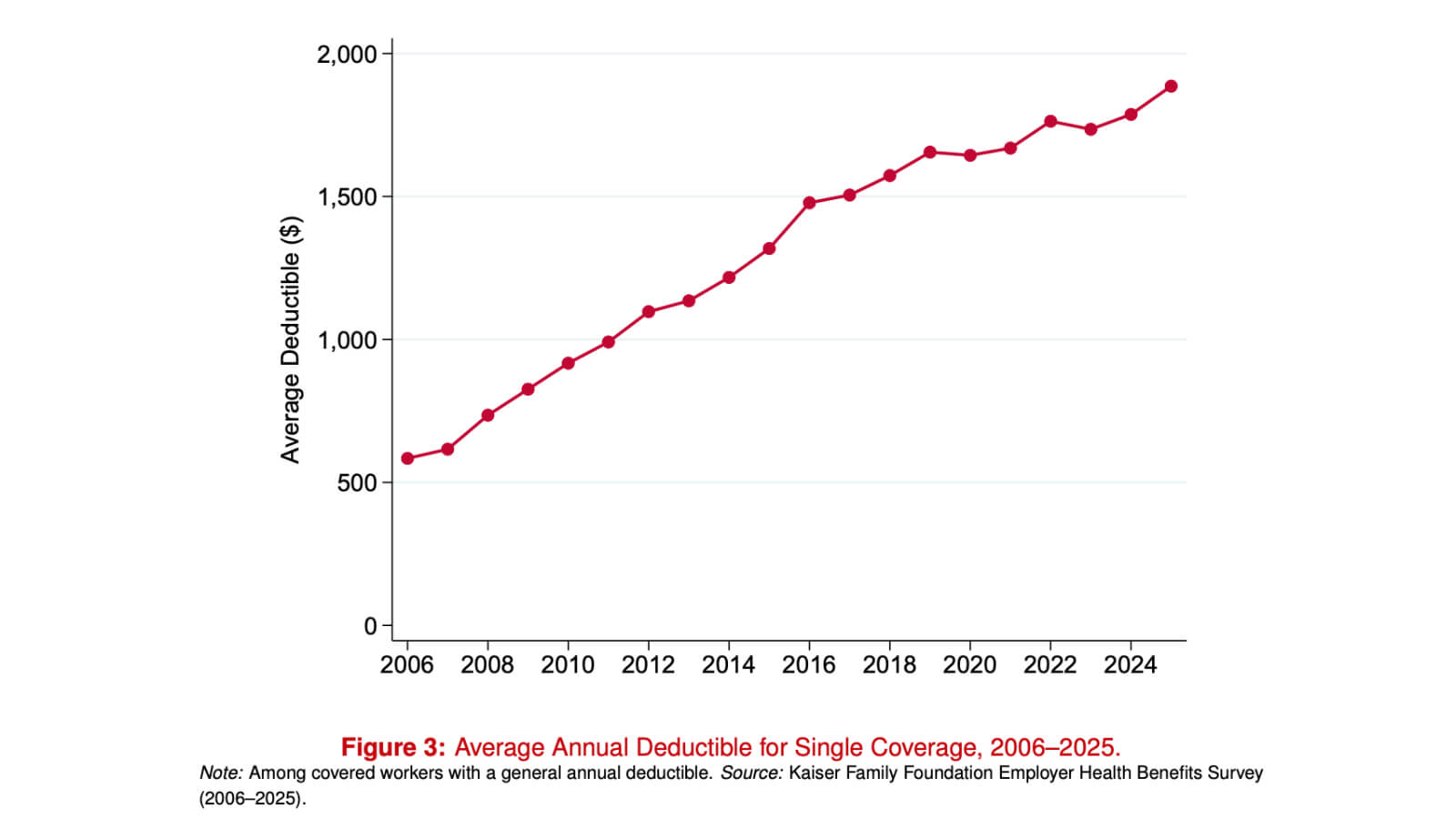
- The average single deductible more than tripled, from $567 in 2006 to $1,886 in 2025.
- Wisconsin hospitals charge private insurers about 321% of Medicare rates. That’s the fourth-highest nationally and the highest in the Midwest (the national average is 254%).
- 93% of Wisconsin employers with health plans saw costs rise in 2026. 88% blame higher provider costs, and 51% cite drug costs.
- 69% of Wisconsin employers say healthcare costs have already forced them to cut hiring, reduce investment, lower compensation, or raise prices.
How Do Healthcare Costs Show Up in Paychecks?
One UW–Madison economist summed it up: Rising healthcare costs are “effectively a pay cut for workers and a tax on employers.”
Healthcare costs reach paychecks in two ways: Costs workers can see on their pay stub, and costs they never see.
1. Direct Costs Workers Can See
- Premium contributions
- Deductibles
- Copays, coinsurance, and prescriptions
For a Wisconsin family earning the median income, the worker share of a family premium now takes about 8.3% of gross pay.
2. Indirect Costs Workers Don’t See
- Money that could go to wages goes to premiums instead. Employers cover about 75% of the average family premium.
- Higher benefit costs leave less room in the budget for new positions.
- Research finds a 1% rise in healthcare prices cuts payroll and jobs at non-healthcare employers by about 0.4% (hidden payroll tax).
The impact is not equal. Health benefits make up a bigger share of total pay for hourly and lower-wage workers, so rising costs hold back their wages the most. The hidden tax falls hardest on people earning $20,000 to $100,000 a year.
What Does This Mean for Hiring & Retention?
- Benefits now drive job decisions: Nearly 1 in 4 workers stay in a job they don’t like to keep their health insurance. Five years ago, it was 1 in 6.
- “Job lock” can hide disengagement: Employees who stay only for coverage may be less productive and more likely to leave once they find better benefits.
- Recruiting gets harder: Insured candidates hesitate to switch jobs unless the benefits are clearly better.
- Competitiveness takes a hit: 92% of employers say healthcare costs hurt their competitiveness.
- Pay pressure is winning over loyalty: Employees are increasingly willing to leave for higher-paying roles — even when it means walking away from years of tenure or a clear path to advancement. As long as a competing offer includes comparable healthcare benefits, compensation alone is enough to drive the move.
Wisconsin business leaders are seeing this firsthand. Some report strong employees considering leaving because they can no longer afford their coverage.
So, What Should Employers Do?
You can’t control the healthcare market or the rising economy, but you can control how you plan, communicate, and hire.
- Be transparent about costs: Share a total compensation statement that shows what you pay toward each worker’s coverage.
- Communicate with team members early: Explain plan changes well before open enrollment. Walk through real examples, like what a typical doctor visit or prescription will cost under each option.
- Ask for clarity on spending: Request claims data from your broker or carrier, and ask how pharmacy costs are priced.
- Review your pay strategy: Look at take-home pay, not just base wages. Benchmark against local competitors, and consider where raises, HSA contributions, or lower-cost plan tiers will matter most to your team.
- Watch for turnover risk: Hourly and lower-wage employees feel rising costs the most. Use stay interviews and check-ins to spot frustration before it becomes a resignation.
- Plan headcount carefully: Match permanent hires to long-term needs, and use flexible staffing for seasonal peaks, special projects, or uncertain demand. If you have 50 or more full-time-equivalent employees, talk with your benefits advisor about Affordable Care Act requirements before changing roles or schedules.
How Staffing Support Specialists Can Help
When every dollar of payroll is under pressure, the right hiring strategy matters even more. This is where Staffing Support Specialists come in.
We’ve helped Southeastern Wisconsin employers reduce hiring risk and improve retention with:
- Direct Hire Staffing: Find long-term workers without managing the recruiting process yourself.
- Temp-to-Perm Staffing: Evaluate candidates on the job before making a permanent hiring decision.
- Payrolling Services: Reduce onboarding risk while we employ your chosen candidate until you’re ready to bring them on.
- Business Consulting & Training: Get support with workforce planning, leadership development, and communicating change.
Contact us today to learn how we can help you navigate your hiring needs.
Frequently Asked Questions
1. Do rising healthcare costs really lower wages?
Yes. Employers whose insurance costs rose gave raises about one percentage point smaller than they otherwise would have. Over time, that adds up.
2. How much will healthcare costs continue to rise?
Employers project healthcare costs will rise about 9% in 2027. Small businesses may see steeper premium increases.
3. Why is healthcare so expensive in Wisconsin?
Hospital prices are the biggest driver. Wisconsin hospitals charge private insurers more than three times Medicare rates, the highest in the Midwest. Limited competition in many regions adds to the problem.
4. How can employers manage rising benefit costs without cutting pay?
Start with clear communication, a close look at plan design and claims data, and a review of take-home pay. Flexible staffing can also help you match headcount to real demand.